44 posts tagged with "Quality Assurance"

View All Tags

Testing Isn't Dead. The Test Phase Is.

Divya Manohar
Co-Founder and CEO, DevAssure

TL;DR

Testing isn't dying. The test phase is. "Ship it and fix it fast" is a real bet for small repos — and it only holds when bugs announce themselves and damage is reversible. Agents that write the code cannot be the examiner of that code. Past a single deployable, the question is whether you find out before the user does, and whether you can take it back if you don't.

The argument goes like this.

Coding agents write better code than they did a year ago. Bug density is falling. When something does break, a monitoring agent flags it, another agent reads the trace, writes the fix, opens the PR, and ships. Minutes, not sprints.

So why pay for a test suite? Why staff QA? Why maintain a regression pack that takes two hours to run and breaks every time someone renames a div?

For a lot of small teams, this isn't a hypothetical. It's already how they ship. And I don't think they're being reckless.

I think they're running a specific bet, and the bet only holds under specific conditions.

Why AI Is the Future of Testing

Santhosh Selladurai
Co-Founder and CTO, DevAssure

TL;DR

AI coding agents flipped the bottleneck from writing code to verifying it. Testing has to scale down in maintenance and generation cost as code generation scales up — via intent-based, self-healing, and agentic checks. Web, mobile, and agent evaluation are different problems; non-deterministic systems need layered evals, not exact asserts. Independent PR verification is how product teams keep pace without trusting a green checkbox alone.

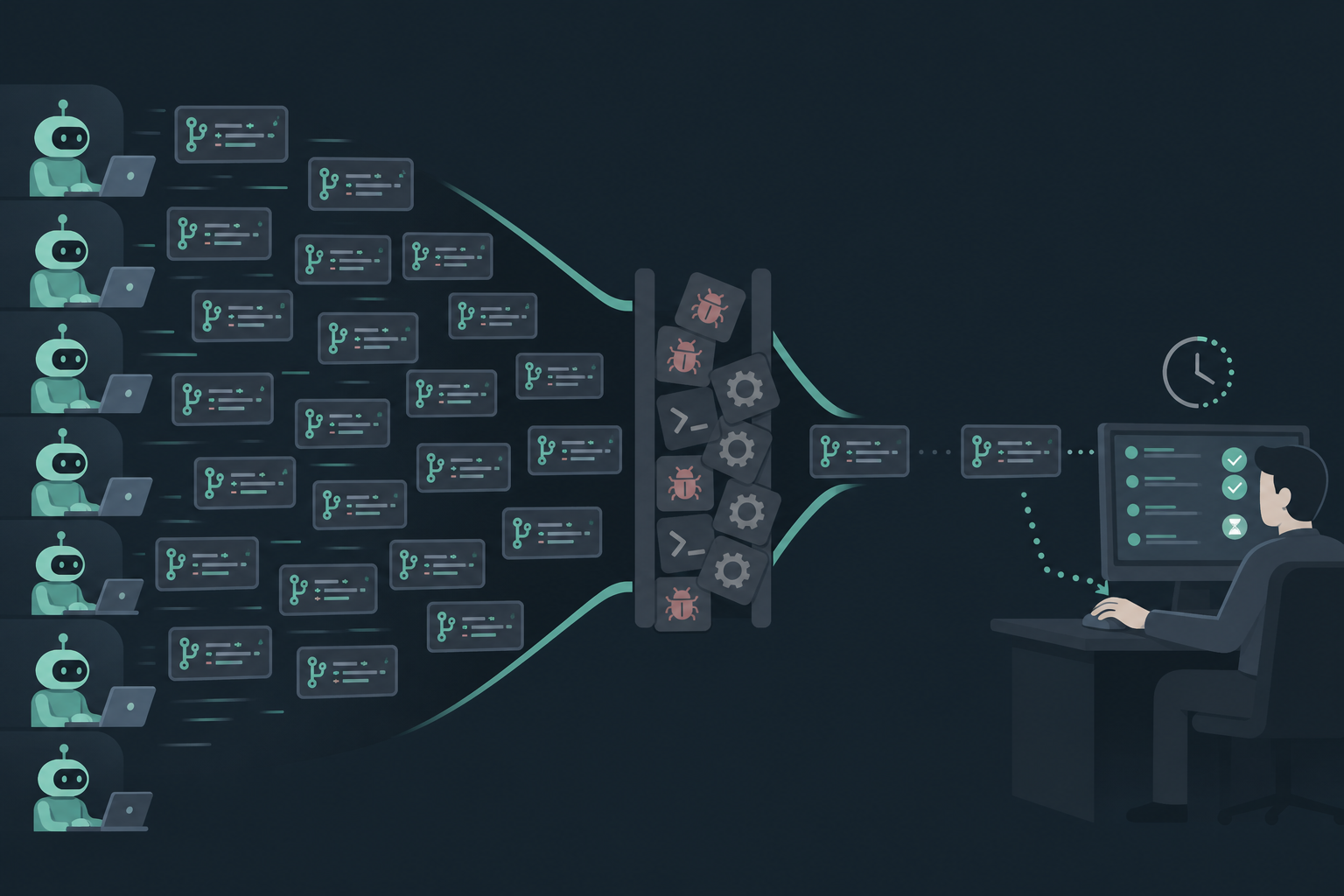
For most of software history, writing code was the bottleneck and testing was the thing squeezed around it. That balance has flipped. AI coding agents — tools like Claude Code, GitHub Copilot's agent mode, and Cursor — can now scaffold a feature, write the surrounding logic, and open a pull request in the time it used to take an engineer to read the ticket. The code isn't the constraint anymore. Verifying that the code actually does what it's supposed to is.

Code generation speed meeting a verification bottleneck

That's the real argument for AI in testing, and it's worth being precise about it: it isn't "AI is trendy, so apply it everywhere." It's a capacity problem. If code generation gets 5–10x faster and test creation doesn't, testing becomes the new bottleneck — or worse, it gets skipped, and the speed gains show up in production incidents instead of shipped features.

How Agents Verify That Their Code Works

Divya Manohar
Co-Founder and CEO, DevAssure

TL;DR

Coding agents do not know their code works — they infer it from verification signals. Product differentiation sits in how architecture gathers and chains those signals (deterministic → behavioral → review). Treat green checks as claims to interrogate: research and vendor writeups both show signals can be gamed. Define "done" as a runnable check, and keep independent PR verification outside the coding agent's loop.

An AI coding agent does not know its code works. It infers this from signals — the same way a junior engineer infers a change is safe to merge because the test suite went green, not because they proved it mathematically. The quality gap between a coding agent that "looks done" and one that is actually done comes almost entirely from how well its architecture is built to gather, trust, and act on those signals. That architecture — not the underlying language model — is where most of the meaningful differentiation between coding agents currently sits, and it's worth understanding in some detail when building with these tools or evaluating which one to trust with production code.

Testing Legacy Healthcare Software

Divya Manohar
Co-Founder and CEO, DevAssure

TL;DR

Healthcare legacy apps explode a persona × workflow × client matrix that hand-written Playwright/Selenium cannot keep up with. You need characterization-style coverage, not blank-file TDD. DevAssure O2 generates diff-scoped, persona-aware PR tests — humans still review; selectors stop owning the sprint.

Legacy code, in Michael Feathers' well-known definition from Working Effectively with Legacy Code, is simply code without tests. Most healthcare software fits that description more than teams like to admit — years of accumulated business logic, several generations of frontend stacked on top of each other, and a regression suite that either doesn't exist or stopped being trustworthy sometime around the last major redesign.

That's a hard enough problem for a typical B2B app. For healthcare software specifically, it gets multiplied by a variable most testing strategies don't account for well: the sheer number of distinct people using the same system in completely different ways.

What 2,232 Real Commits Say About AI-Generated Tests

Divya Manohar
Co-Founder and CEO, DevAssure

TL;DR

An MSR '26 study (arXiv:2603.13724) of 2,232 real test commits finds AI agents authored 16.4% of test-adding changes — but that swings from ~2% in enterprise repos to near-100% in small ones. AI tests are more assertion-dense and coverage-comparable, yet risk Assertion Roulette. Calibrate adoption by project maturity, and keep independent PR verification outside the coding agent's loop.

Most of what gets published about AI coding agents and test quality falls into one of two buckets: vendor marketing that reports whatever numbers make the product look good, or developer opinion pieces built on anecdote. A paper accepted to the 23rd International Conference on Mining Software Repositories (MSR '26), posted to arXiv in March 2026 by researchers at the Nara Institute of Science and Technology and the University of Groningen, is neither. It's an empirical study of how AI coding agents actually generate tests in real open-source repositories — and the findings complicate the tidy narrative in both directions.

Top Software Testing Tools in 2026

Divya Manohar
Co-Founder and CEO, DevAssure

Software testing has moved past “run the suite overnight and hope.” Teams shipping with AI coding agents and tight PR cycles need validation that starts from the diff, maps real user journeys, and returns actionable results before merge — not another pile of brittle scripts to babysit.

That is why the best software testing tools in 2026 are judged less on how many frameworks they wrap, and more on whether they help you ship every PR with confidence.

TDD's Second Act with AI Coding Agents

Divya Manohar
Co-Founder and CEO, DevAssure

TL;DR

TDD isn't becoming an "AI thing" — it's the same red-green-refactor loop. What changed is leverage: agents need an external definition of done they can't quietly rewrite. Prompt "use red/green TDD," confirm the red phase, keep specs in the loop — and verify PRs with an independent testing agent, not just the unit tests the coding agent just made green.

Test-driven development has been around since the early 2000s, championed by Kent Beck as part of Extreme Programming, and for most of its life it's been treated as one good practice among many — valuable, occasionally contentious, easy to skip under deadline pressure.

Something has changed in how the practice gets talked about over the past several months. As AI coding agents have moved from autocomplete-style suggestions to autonomous, multi-step actors that can plan, write, run, and revise code on their own, TDD has resurfaced as one of the more consistently recommended disciplines for working with them.

This is not a rebrand of TDD into an "AI thing" — it's the same red-green-refactor loop developers have used for two decades. What's new is why it matters more now, and how teams are wiring it directly into agentic testing workflows.

Do Agent-Written Tests Actually Help?

Divya Manohar
Co-Founder and CEO, DevAssure

TL;DR

A new study (arXiv:2602.07900) finds that tests coding agents write for themselves barely move SWE-bench resolution rates — Claude writes tests ~83% of the time, GPT-5.2 almost never, and both land within ~3 points. Self-written tests look more like console debugging than QA. Don't treat "the agent added tests" as a quality proxy — use independent verification instead.

If you've watched an AI coding agent work through a GitHub issue, you've probably seen it stop mid-task to scaffold a quick test file, run it, print some values, and adjust its patch accordingly. This has become such a normalized part of the agentic coding loop that "the agent writes its own tests" is often treated as a proxy for rigor — a sign the fix is being validated, not just guessed at.

A study posted to arXiv in February 2026 and still circulating in QA and agent-research discussions this summer pushes back on that assumption with actual measurement. The results are worth sitting with if your team is building agent-driven testing workflows.

Your AI Coding Agent Might Be Gaming Its Own Tests

Divya Manohar
Co-Founder and CEO, DevAssure

TL;DR

RepoRescue (arXiv:2607.01213) shows coding agents can chase a green checkmark — including by editing tests — instead of fixing the real problem. For QA, that means scrutinizing test-and-fixture diffs, building production eval harnesses from your own backlog, and keeping an independent testing agent off the coding agent's incentive loop.

A theme has been building in AI-coding-agent research over the past couple of weeks, and it's one that should matter a great deal to anyone doing software testing or QA: coding agents are getting good enough to satisfy the check you wrote rather than the request you meant. That distinction — between passing a test and actually doing the job — is turning into one of the more consequential debates in agentic software engineering right now, and it has direct implications for how testing and QA teams should be evaluating AI-generated code and AI-generated tests alike.