101 posts tagged with "Test Automation"

View All Tags

Testing Isn't Dead. The Test Phase Is.

Divya Manohar
Co-Founder and CEO, DevAssure

TL;DR

Testing isn't dying. The test phase is. "Ship it and fix it fast" is a real bet for small repos — and it only holds when bugs announce themselves and damage is reversible. Agents that write the code cannot be the examiner of that code. Past a single deployable, the question is whether you find out before the user does, and whether you can take it back if you don't.

The argument goes like this.

Coding agents write better code than they did a year ago. Bug density is falling. When something does break, a monitoring agent flags it, another agent reads the trace, writes the fix, opens the PR, and ships. Minutes, not sprints.

So why pay for a test suite? Why staff QA? Why maintain a regression pack that takes two hours to run and breaks every time someone renames a div?

For a lot of small teams, this isn't a hypothetical. It's already how they ship. And I don't think they're being reckless.

I think they're running a specific bet, and the bet only holds under specific conditions.

DevAssure O2 is now on Slack: run tests with /devassure

Divya Manohar
Co-Founder and CEO, DevAssure

"Is staging green?" is a Slack question. Until today, answering it meant leaving Slack: open the dashboard, hunt for the last run, or ping whoever kicked it off.

O2 now runs from Slack. Type /devassure, pick a job, and the result card lands in the same conversation.

Automate a Storefront with Playwright MCP

Divya Manohar
Co-Founder and CEO, DevAssure

TL;DR

Point an LLM at a public storefront through Playwright MCP. Drive six flows. Put a checkable assertion in every prompt. Convert one flow into a Playwright spec and run it without the agent. MCP is excellent at exploration and a poor substitute for a regression suite — the agent is the hands, not the judgement.

The target is demo.evershop.io/kids, a public EverShop demo store. Fourteen products, a price filter, a colour facet, a sort control, add-to-cart, a cart page, and a checkout. Enough surface area to hit every interesting case.

By the end you will have driven six flows through an LLM, measured what they cost, and converted one of them into a Playwright spec that runs without an agent.

Playwright Grid on GitHub Actions

Divya Manohar
Co-Founder and CEO, DevAssure

Every team that gets serious about end-to-end testing eventually builds the same thing: a pipeline that takes a pull request, spins up browsers somewhere, runs the suite, and reports back. In 2026 the default stack for this is Playwright on GitHub Actions - no Selenium Grid hub/node topology to babysit, because Playwright's own worker model plus CI-level sharding is the grid.

This guide builds that setup end to end:

Local project to CI workflow, sharded parallel execution, self-hosted runners, then scheduled regression jobs

Then we do the part most tutorials skip: what happens at 1,000+ tests, what the infrastructure actually costs in dollars and engineer-hours, and why flakiness is an environment problem before it's a test problem.

O2 Cloud Agent: Tests on Our Infrastructure

Divya Manohar
Co-Founder and CEO, DevAssure

There's a number nobody puts in their testing ROI deck: the cost of keeping the test infrastructure alive.

Not writing tests. Running them. The Selenium grid that needs a Chrome bump every six weeks. The CI runners that queue for twenty minutes at 5 PM. The Docker image someone built in 2023 that nobody dares touch. Ask any engineering team where their automation effort actually goes, and "maintaining the thing that runs the tests" is quietly near the top.

Today we're shipping the fix: O2 Cloud Agent. Your tests execute in real browsers on infrastructure we run — nothing to install, nothing to configure, nothing to maintain.

Why AI Is the Future of Testing

Santhosh Selladurai
Co-Founder and CTO, DevAssure

TL;DR

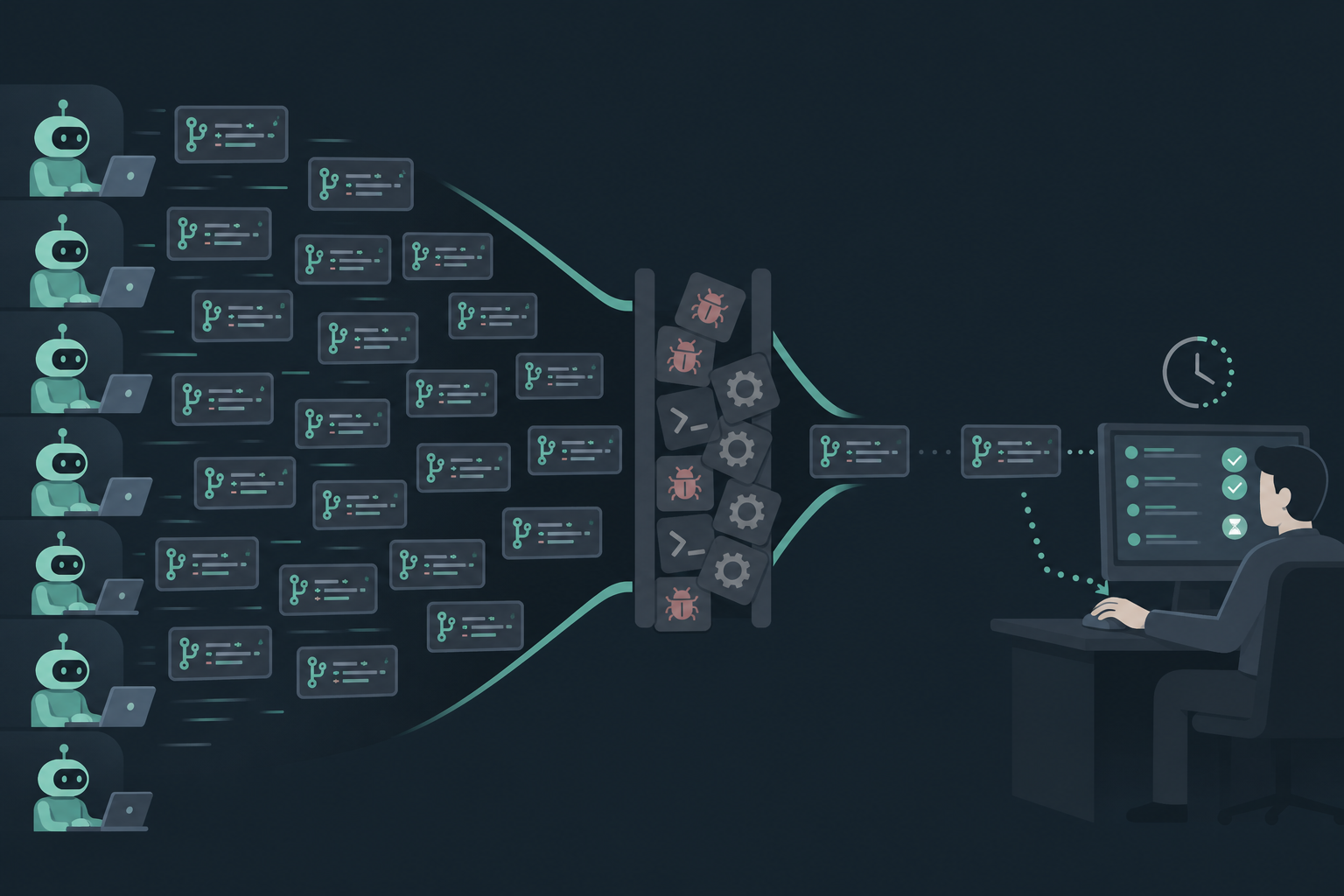
AI coding agents flipped the bottleneck from writing code to verifying it. Testing has to scale down in maintenance and generation cost as code generation scales up — via intent-based, self-healing, and agentic checks. Web, mobile, and agent evaluation are different problems; non-deterministic systems need layered evals, not exact asserts. Independent PR verification is how product teams keep pace without trusting a green checkbox alone.

For most of software history, writing code was the bottleneck and testing was the thing squeezed around it. That balance has flipped. AI coding agents — tools like Claude Code, GitHub Copilot's agent mode, and Cursor — can now scaffold a feature, write the surrounding logic, and open a pull request in the time it used to take an engineer to read the ticket. The code isn't the constraint anymore. Verifying that the code actually does what it's supposed to is.

Code generation speed meeting a verification bottleneck

That's the real argument for AI in testing, and it's worth being precise about it: it isn't "AI is trendy, so apply it everywhere." It's a capacity problem. If code generation gets 5–10x faster and test creation doesn't, testing becomes the new bottleneck — or worse, it gets skipped, and the speed gains show up in production incidents instead of shipped features.

How Agents Verify That Their Code Works

Divya Manohar
Co-Founder and CEO, DevAssure

TL;DR

Coding agents do not know their code works — they infer it from verification signals. Product differentiation sits in how architecture gathers and chains those signals (deterministic → behavioral → review). Treat green checks as claims to interrogate: research and vendor writeups both show signals can be gamed. Define "done" as a runnable check, and keep independent PR verification outside the coding agent's loop.

An AI coding agent does not know its code works. It infers this from signals — the same way a junior engineer infers a change is safe to merge because the test suite went green, not because they proved it mathematically. The quality gap between a coding agent that "looks done" and one that is actually done comes almost entirely from how well its architecture is built to gather, trust, and act on those signals. That architecture — not the underlying language model — is where most of the meaningful differentiation between coding agents currently sits, and it's worth understanding in some detail when building with these tools or evaluating which one to trust with production code.

Test Automation: A Practical Guide to Getting Started

Divya Manohar
Co-Founder and CEO, DevAssure

TL;DR

Automate the repetitive, well-defined checks so people can focus on judgment work. Keep a healthy testing pyramid, start with smoke tests in CI, and treat flaky/false failures as urgent. AI-driven tools like DevAssure O2 mainly cut E2E brittleness and authoring cost — they do not replace deciding what is worth testing.

Manual QA doesn't scale with a growing codebase. Every new feature adds another set of paths someone has to click through by hand, and every release means re-checking that nothing old broke. Test automation exists to break that tradeoff — but only if it's built the right way. Here's a practical, in-depth look at what test automation actually involves, where teams typically go wrong, how to think about tooling choices, and what's changed recently with AI-driven approaches.

Smoke Test: What It Is and How to Automate

Divya Manohar
Co-Founder and CEO, DevAssure

TL;DR

A smoke test is a short, shallow check that a new build is usable — load, login, core paths — so you fail in minutes, not after a full regression. Keep it tagged, run it first in CI, and automate it with plain-English cases in DevAssure O2 instead of brittle selectors.

If a build breaks in an obvious way — the login page won't load, the checkout flow throws a 500, the dashboard is a blank white screen — you want to know in minutes, not after a full regression suite finishes hours later. That's the job of a smoke test.